> For the complete documentation index, see [llms.txt](https://help.docexport.com/llms.txt). Markdown versions of documentation pages are available by appending `.md` to page URLs; this page is available as [Markdown](https://help.docexport.com/template/qr-code.md).
# QR Code
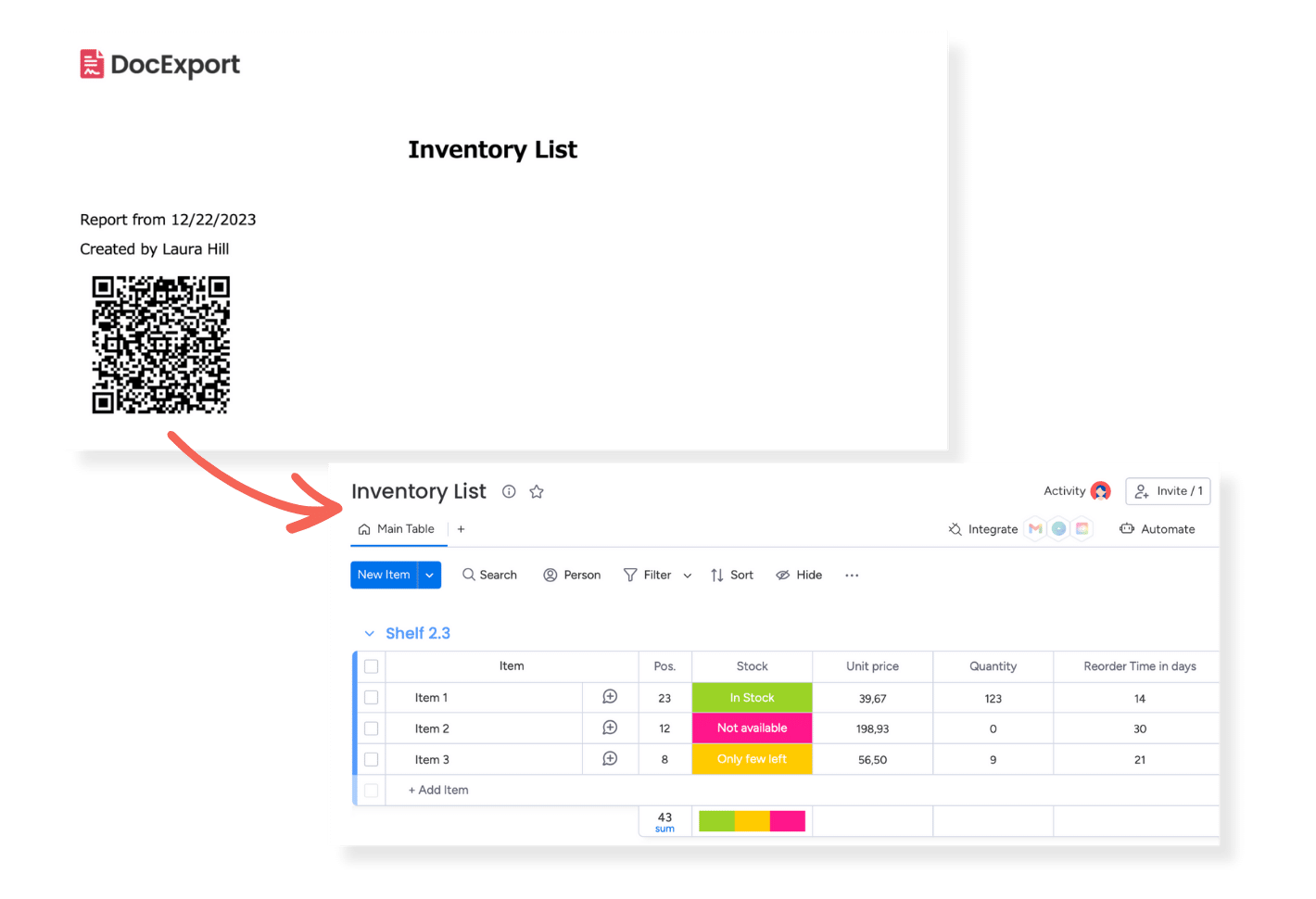
Create QR codes in your documents with links to the board or the specific item.
{% hint style="success" %}
*This feature is included in the* [*Professional Plan*](https://www.docexport.com/professionalfeatures/) *and above.*
{% endhint %}
## Use QR codes in your documents
There are two options of QR codes with DocExport:
1. QR code with link to item (item Url)
2. QR code with link to the Url in any link column
A typical use case is inventory management - if you want to create a quick link to a specific item and place it in the warehouse.
**Note:** QR Codes are only available for the DocExport [Professional](https://www.docexport.com/pricing/) and [Enterprise](https://www.docexport.com/pricing/) plans.
**Option 1: Add QR code with link to the item in monday.com**
Use this placeholder to create a QR code for the specific item and place it in your docx template:
`{{Image(100;0):QR.ItemUrl}}`
**Option 2: Add QR code with link from a link column**
Use this placeholder to create a QR code which links to the link in any link column. For example the link to the client website.
`{{Image(100;0):QR.Column Title}}`
If the title of your link column is 'Client Website', the placeholder would be `{{Image(100;0):QR.Client Website}}`
#### **Change the size of the QR code**
You can also define the size of the QR code. To do this, change the part in brackets after *Image*:
`{{Image(100;0):QR.ItemUrl}}`
The "100" in the placeholder defines the image's width in pixels.
Enter the size of the image in pixels, separated by a semicolon. If the second value is specified with a 0, the image will be output in aspect ratio.
If you change the `{{Image(100;0):QR.ItemUrl}}` to `{{Image(200;0):QR.ItemUrl}}`, it's double the size on the final document.
You can also specify the size in percent: `{{Image(50%;50%):QR.ItemUrl}}`.